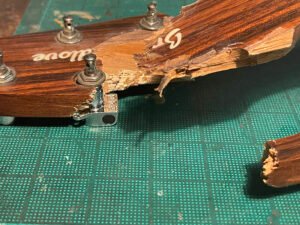
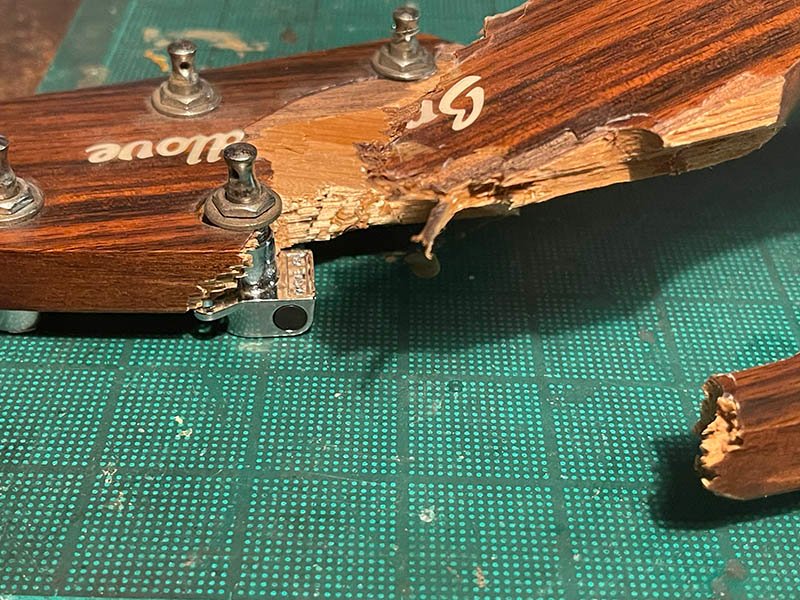
In the chronicles of guitar restoration, our tale begins with a friend’s heart-wrenching accident—a beloved Breedlove acoustic, once proudly perched on its stand, reduced to a shattered headstock in three disheartening pieces. Weeks later, the wounded instrument found its way into my hands, and the meticulous process of resurrection commenced.
Given the directive to prioritize playability over aesthetics, I first assessed the puzzle at hand. Miraculously, the fractured chunks interlocked with surprising precision. Armed with Titebond II wood glue, the reconstruction unfolded systematically. Each piece was meticulously coated, clamped, and left to cure for days, a patient dance with adhesion and restoration.
For the delicate fragments, surgical tubing played a crucial role in maintaining alignment. Clamps, gentle yet firm, ensured a seamless bond. The larger, absent wedge required a surgical touch—chiseling out a cleaner rectangle, crafting a piece of hard poplar wood, and securing it into the void with precise gluing and clamping.
With the glue’s final cure, a critical test awaited. Attempting to pry off the headstock yielded no movement; confidence surged that it would withstand the tension of newly strung strings.
The visual redemption journey began with the application of a new piece of rosewood veneer to match the front of the headstock. Precision was paramount as I re-drilled the tuning peg holes using the original holes as a guide. The back, sanded smooth yet visually lacking, prompted a creative solution.
A second layer of rosewood veneer, meticulously cut to match the headstock’s shape, presented a challenge. To ensure a smooth transition to the back of the neck, the veneer underwent careful sanding, creating an imperceptible blend. Wood filler filled any remaining seams, and the visual integration was seamless to the touch.